Details
-
Bug
-
Status: Open (View Workflow)
-
 Critical
-
Resolution: Unresolved
-
12.3.2
-
None
-
Windows 11
-
Can result in unexpected behaviour
-
Description
An existing application database uses utf8mb4_spanish_ci. Migration scripts
historically and commonly declare tables as follows:
CREATE TABLE example (...) |
ENGINE=InnoDB DEFAULT CHARSET=utf8mb4; |
On MariaDB 12.3.2, specifying DEFAULT CHARSET=utf8mb4 without an explicit
COLLATE selects utf8mb4_uca1400_ai_ci, even when the database was explicitly
created with utf8mb4_spanish_ci.
This silently produces a schema in which old and new physical columns use
different collations. Comparisons between those columns then abort with error
1267 because both operands have IMPLICIT coercibility.
We understand that selecting the default collation of an explicitly specified
character set is documented behavior. The compatibility impact is nevertheless
severe: a DDL pattern that was safe and extremely common before the default
Unicode collation changed can now make essential production queries fail.
Minimal reproducible example
The following script was executed successfully up to the final SELECT on
MariaDB 12.3.2. It does not require any application code.
DROP DATABASE IF EXISTS mdev_collation_repro; |
|
|
SET NAMES utf8mb4; |
|
|
CREATE DATABASE mdev_collation_repro |
CHARACTER SET utf8mb4 |
COLLATE utf8mb4_spanish_ci; |
|
|
USE mdev_collation_repro; |
|
|
SELECT DATABASE(), |
@@character_set_database,
|
@@collation_database,
|
@@character_set_connection,
|
@@collation_connection;
|
|
|
CREATE TABLE physical_table ( |
code VARCHAR(50) |
);
|
|
|
CREATE TABLE charset_only_table ( |
code VARCHAR(50) |
) DEFAULT CHARSET=utf8mb4; |
|
|
INSERT INTO physical_table VALUES ('TEST'); |
INSERT INTO charset_only_table VALUES ('TEST'); |
|
|
SELECT TABLE_NAME, |
TABLE_COLLATION
|
FROM INFORMATION_SCHEMA.TABLES |
WHERE TABLE_SCHEMA = DATABASE() |
AND TABLE_TYPE = 'BASE TABLE' |
ORDER BY TABLE_NAME; |
|
|
SELECT TABLE_NAME, |
COLUMN_NAME,
|
CHARACTER_SET_NAME,
|
COLLATION_NAME
|
FROM INFORMATION_SCHEMA.COLUMNS |
WHERE TABLE_SCHEMA = DATABASE() |
AND TABLE_NAME IN ('physical_table', 'charset_only_table') |
ORDER BY TABLE_NAME, COLUMN_NAME; |
|
|
SELECT physical.code, |
current_table.code
|
FROM physical_table physical |
JOIN charset_only_table current_table |
ON current_table.code = physical.code; |
|
|
DROP DATABASE mdev_collation_repro; |
The cleanup statement must be executed separately after the failing SELECT
if the SQL client stops processing the script on the first error.
Actual result
The database and connection values immediately after USE are:
database: mdev_collation_repro
|
character_set_database: utf8mb4
|
collation_database: utf8mb4_spanish_ci
|
character_set_connection: utf8mb4
|
collation_connection: utf8mb4_uca1400_ai_ci
|
The two tables receive different collations:
+--------------------+-----------------------+
|
| TABLE_NAME | TABLE_COLLATION |
|
+--------------------+-----------------------+
|
| charset_only_table | utf8mb4_uca1400_ai_ci |
|
| physical_table | utf8mb4_spanish_ci |
|
+--------------------+-----------------------+
|
Their code columns receive the same respective collations:
+--------------------+-------------+--------------------+-----------------------+
|
| TABLE_NAME | COLUMN_NAME | CHARACTER_SET_NAME | COLLATION_NAME |
|
+--------------------+-------------+--------------------+-----------------------+
|
| charset_only_table | code | utf8mb4 | utf8mb4_uca1400_ai_ci |
|
| physical_table | code | utf8mb4 | utf8mb4_spanish_ci |
|
+--------------------+-------------+--------------------+-----------------------+
|
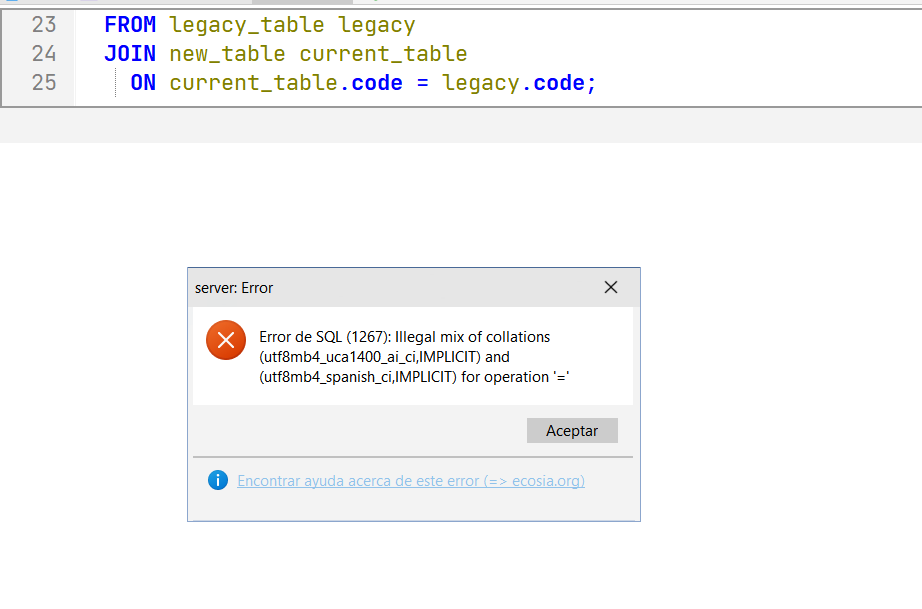
The final join fails:
ERROR 1267 (HY000): Illegal mix of collations
|
(utf8mb4_uca1400_ai_ci,IMPLICIT) and
|
(utf8mb4_spanish_ci,IMPLICIT) for operation '='
|
Expected result from an upgrade-compatibility perspective
When a table specifies the same character set already configured as the
database default but does not specify another collation, users commonly expect
the database collation to remain effective.
At minimum, an upgrade or migration warning should make it prominent that:
CREATE TABLE inherited_table (...); |
and:
CREATE TABLE charset_only_table (...) |
DEFAULT CHARSET=utf8mb4; |
can create tables with different collations inside the same database after the
default collation associated with utf8mb4 changes.
Production impact
The affected application database was explicitly configured as:
character set: utf8mb4
|
collation: utf8mb4_spanish_ci
|
The incident prevented essential queries from executing. It was not a sorting
difference or a cosmetic change: joins between physical columns aborted with
error 1267.
SET NAMES utf8mb4 COLLATE utf8mb4_spanish_ci does not repair comparisons
between already-created physical columns. Both column operands have IMPLICIT
coercibility, so neither collation wins.
Recovery required detecting every deviating textual column and executing
operations such as:
ALTER TABLE affected_table |
CONVERT TO CHARACTER SET utf8mb4 |
COLLATE utf8mb4_spanish_ci; |
These operations can rebuild tables, consume significant time and storage, and
require a maintenance window in a production environment.
Evidence from the affected database
After recovery, direct inspection on MariaDB 12.3.2 showed:
- The database default is utf8mb4_spanish_ci.
- All 143 base tables are currently normalized to utf8mb4_spanish_ci.
- Selecting the database changes @@collation_database to
utf8mb4_spanish_ci, but @@collation_connection remains
utf8mb4_uca1400_ai_ci. - Several derived columns in existing views retain the connection collation
used when those views were created. This is a secondary migration hazard for
literals, CASE expressions and UNION results, although the minimal example
above deliberately demonstrates the production error using physical columns.
An earlier check of @@collation_database performed without selecting the
application database returned the server default. After executing `USE
factuzam{{, MariaDB correctly reported }}utf8mb4_spanish_ci`. Therefore, this
report does not claim that CREATE DATABASE ... COLLATE itself is ignored.
The demonstrated problem is the silent selection of the character set's new
default collation when table DDL repeats DEFAULT CHARSET=utf8mb4 without an
explicit COLLATE.
Workarounds applied
All table creation scripts have been changed to specify both attributes:
ENGINE=InnoDB
|
DEFAULT CHARSET=utf8mb4 |
COLLATE=utf8mb4_spanish_ci; |
Existing databases are audited through INFORMATION_SCHEMA.TABLES and
INFORMATION_SCHEMA.COLUMNS. Deviating tables are converted explicitly.
The application also sets the connection collation after connecting:
SET NAMES utf8mb4 COLLATE utf8mb4_spanish_ci; |
This protects literals, parameters and newly created derived objects, but it
cannot repair physical columns that were already created with another
collation.
Requested improvement
We suggest one or more of the following:
- Add a prominent compatibility warning to the upgrade documentation for the
change to uca1400_ai_ci. - Explicitly highlight that DEFAULT CHARSET=utf8mb4 can override an existing
database collation when no table-level COLLATE is provided. - Provide a documented pre-upgrade audit query for mixed table and column
collations. - Provide an official migration procedure for preserving the existing
database collation. - Consider whether specifying the same charset as the database, without a
collation, should continue inheriting the database collation or should at
least generate a warning when it differs. - Document that USE database_name updates collation_database but does not
align collation_connection, which can affect literals and stored view
expressions created during imports.
Suggested audit query
SELECT T.TABLE_NAME, |
T.TABLE_COLLATION,
|
C.COLUMN_NAME,
|
C.CHARACTER_SET_NAME,
|
C.COLLATION_NAME
|
FROM INFORMATION_SCHEMA.TABLES T |
JOIN INFORMATION_SCHEMA.COLUMNS C |
ON C.TABLE_SCHEMA = T.TABLE_SCHEMA |
AND C.TABLE_NAME = T.TABLE_NAME |
WHERE T.TABLE_SCHEMA = 'application_database' |
AND T.TABLE_TYPE = 'BASE TABLE' |
AND C.CHARACTER_SET_NAME IS NOT NULL |
AND ( |
C.CHARACTER_SET_NAME <> 'utf8mb4' |
OR C.COLLATION_NAME <> 'utf8mb4_spanish_ci' |
)
|
ORDER BY T.TABLE_NAME, |
C.ORDINAL_POSITION;
|
Attachment
Attach the screenshot showing the final join and the complete error 1267. The
screenshot corresponds to the minimal mixed-physical-column comparison shown
above.
Attachments
Issue Links
- blocks
-
-
- Confirmed
-
- relates to
-
MDEV-19123 Change default charset from latin1 to utf8mb4
-
- Closed
-
- has action item
-
DOCS-6553 Loading...